The Texts
EZRA exists simultaneously as a contemporary art practice, living archive, and system.
The texts provide the framework through which the work can be understood.
They are not separate from the archive, but another form through which its structure becomes visible.
Together, the Standards Manual and Companion Manual define the architecture of EZRA while documenting how that architecture is lived in practice.
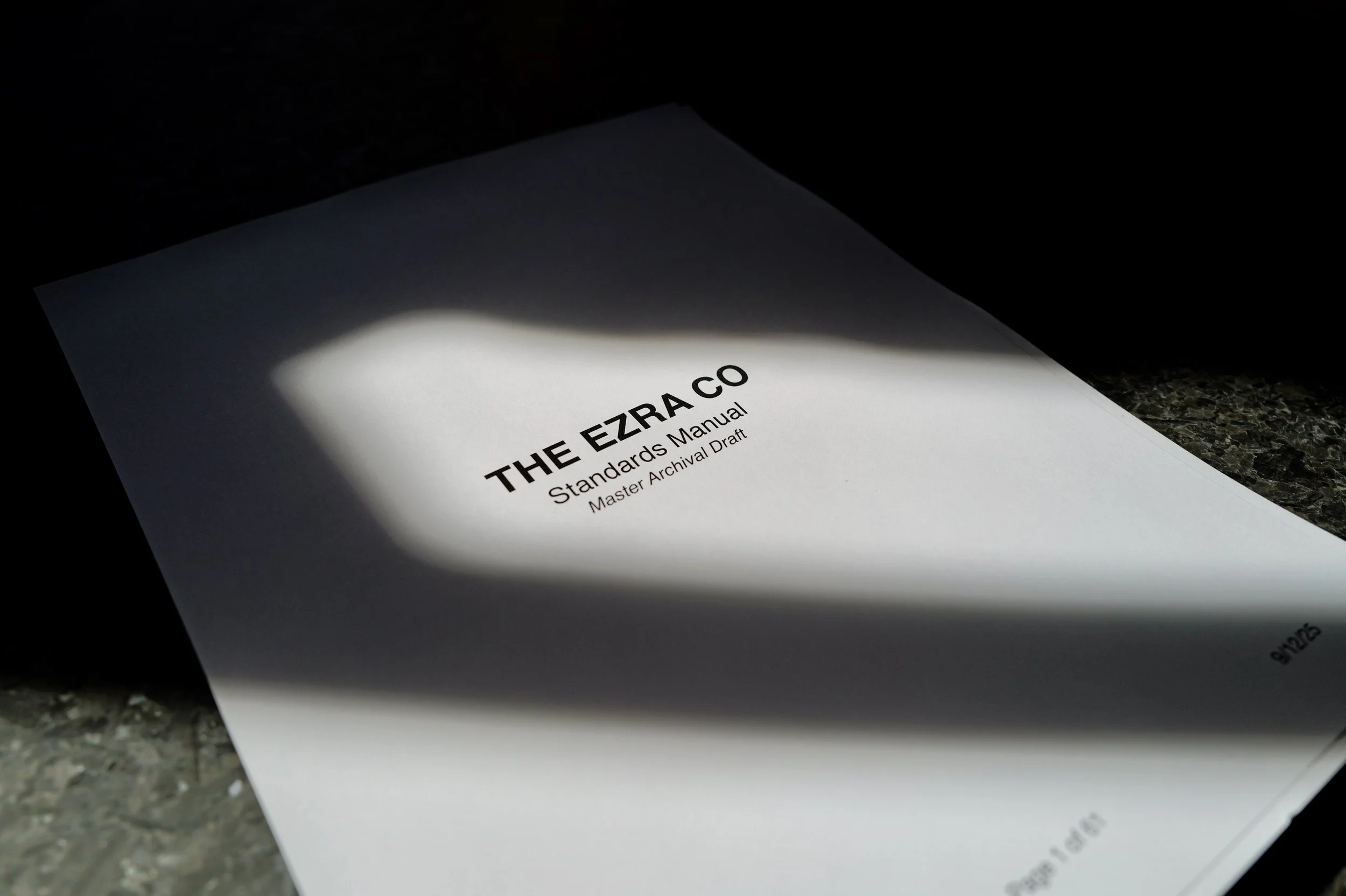
The Standards Manual
The Standards Manual is the structural document of EZRA.
It defines the architecture of the system and establishes the principles that govern how the work operates across practice, archive, exhibition, and future instantiations.
Rather than functioning as an artist statement, it defines the conditions under which meaning becomes legible.
The Standards Manual establishes the boundaries of the system: what it includes, how it behaves, and how its components relate to one another over time.
It does not explain individual artworks.
It explains the structure that allows them to emerge.
As a result, it provides a stable framework through which the work can be understood not as a collection of isolated outputs, but as a coherent practice built around duration, recognition, and meaning.

The Companion Manual
The Companion Manual documents the lived experience of EZRA.
Where the Standards Manual defines structure, the Companion Manual records what happens when that structure is lived through daily practice.
Attention, documentation, fieldwork, object observation, sonic looping, and return are treated not as techniques, but as conditions through which meaning becomes recognizable.
It does not prescribe interpretation.
Instead, it remains close to experience as it unfolds, documenting the methods through which photographs, objects, places, memories, and relationships are encountered, held, and revisited over time.
The Companion Manual is not a guide to the system.
It is a record of the artist living within it.
Together, the Standards Manual and Companion Manual define both the structure of EZRA and the practice through which that structure becomes visible.